Print & Out-of-Home
Print advertising is not dead, just pricier
Circulation has fallen and cost per contact has risen. What has also risen is the attention a printed page receives, and that changes the sum.
2 min readNov 2, 2025
Print & Out-of-Home
Screens allow the message to change by hour, weather and event. Most advertisers buy them and run one static image for a fortnight.
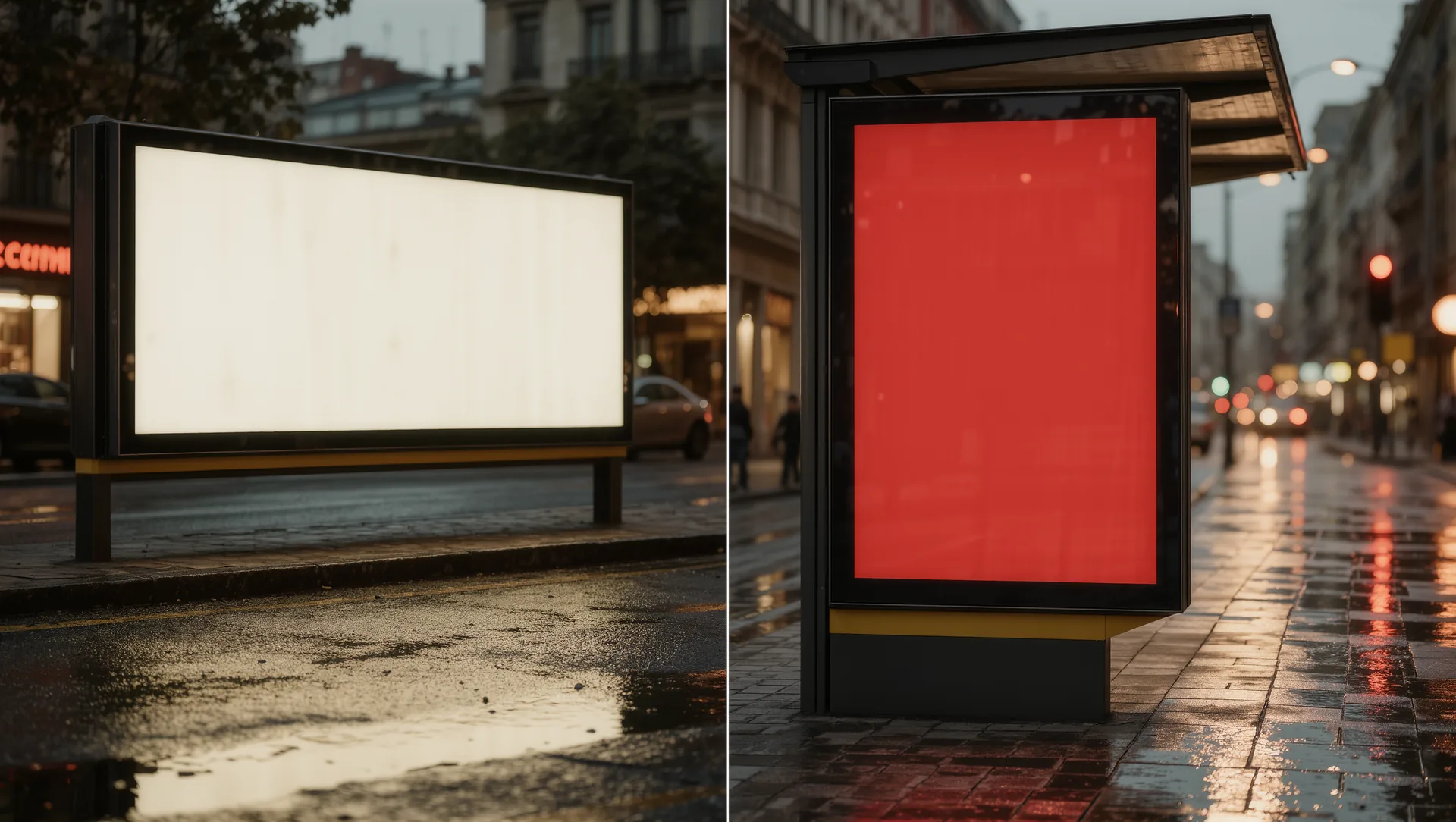
Digital screens have replaced a substantial share of outdoor inventory. The medium is bought in the same way as paper by most advertisers, which forgoes its only real advantage.
Not a site, but a share of a loop. Six to eight advertisers rotate, each appearing for a few seconds per cycle.
That has two consequences. Your message is absent most of the time, and it appears alongside whatever else is in the rotation, which you generally cannot control.
| Trigger | Application |
|---|---|
| Time of day | breakfast offer in the morning, dinner in the evening |
| Day of week | different message at the weekend |
| Weather | rain, temperature, pollen, first frost |
| Traffic conditions | relevant for services near congestion |
| Stock or availability | last remaining, sold out |
| Event or result | local sports, local news |
| Countdown | days remaining to a deadline |
A garden centre showing a different product depending on temperature, or a tyre retailer triggered by a frost warning, is using the medium as intended.
Setting this up requires a creative set rather than a single file, and a supplier who supports the triggers. Both are available and rarely requested.
Screens allow motion, and most outdoor regulations restrict it. Typical rules prohibit video, rapid transitions and anything that could distract drivers.
Subtle motion, such as a single element moving or a simple transition, is usually permitted and measurably increases attention. Check the local regulation before designing.
Digital outdoor can be bought programmatically, which allows audience-based buying and rapid activation.
The realistic assessment: useful for flexibility and for triggered campaigns, and it introduces the same intermediation costs as programmatic display. For a local advertiser buying five screens, a direct booking is usually cheaper.
High-dwell environments where the loop is seen several times: transport interchanges, shopping centres, waiting areas, petrol forecourts.
In those settings the rotation disadvantage disappears, because the viewer is present for several cycles.
Roadside sites passed once at speed, where continuous presence matters more than variability, and any campaign where the budget is better spent on more sites than on a shorter share of fewer.
Per site usually yes, but you buy a share of a rotation rather than the whole site. Compare on cost per thousand contacts.
Six to eight advertisers in a loop, each getting a slot of six to ten seconds every minute or two.
More from Print & Out-of-Home
Print & Out-of-Home
Circulation has fallen and cost per contact has risen. What has also risen is the attention a printed page receives, and that changes the sum.
Print & Out-of-Home
The rate card is a starting point, the position matters more than the size, and the readership figure is not the number you should plan with.
Print & Out-of-Home
Small circulations, high cost per thousand, and almost no waste. For business-to-business advertisers this is frequently the most efficient channel available.